Creating Your First Instance
After you finish installing Terrarium, the host server is fully configured, secured, and ready. You never actually need to touch the command line again if you prefer a visual workflow.
All of your host management (storage, network, system logs) can be done through the Cockpit dashboard. All of your container management (creating environments, routing traffic, taking snapshots) can be done through the LXD UI.
This guide creates a container and publishes an app. For an instance with its own kernel, follow the Linux VM guide; the application and routing commands below also apply to VMs.
1. Creating the Container
You can choose whether you want to work through the browser or the terminal. Both paths do exactly the same thing.
The Visual Way (LXD UI)
- Open your LXD dashboard at
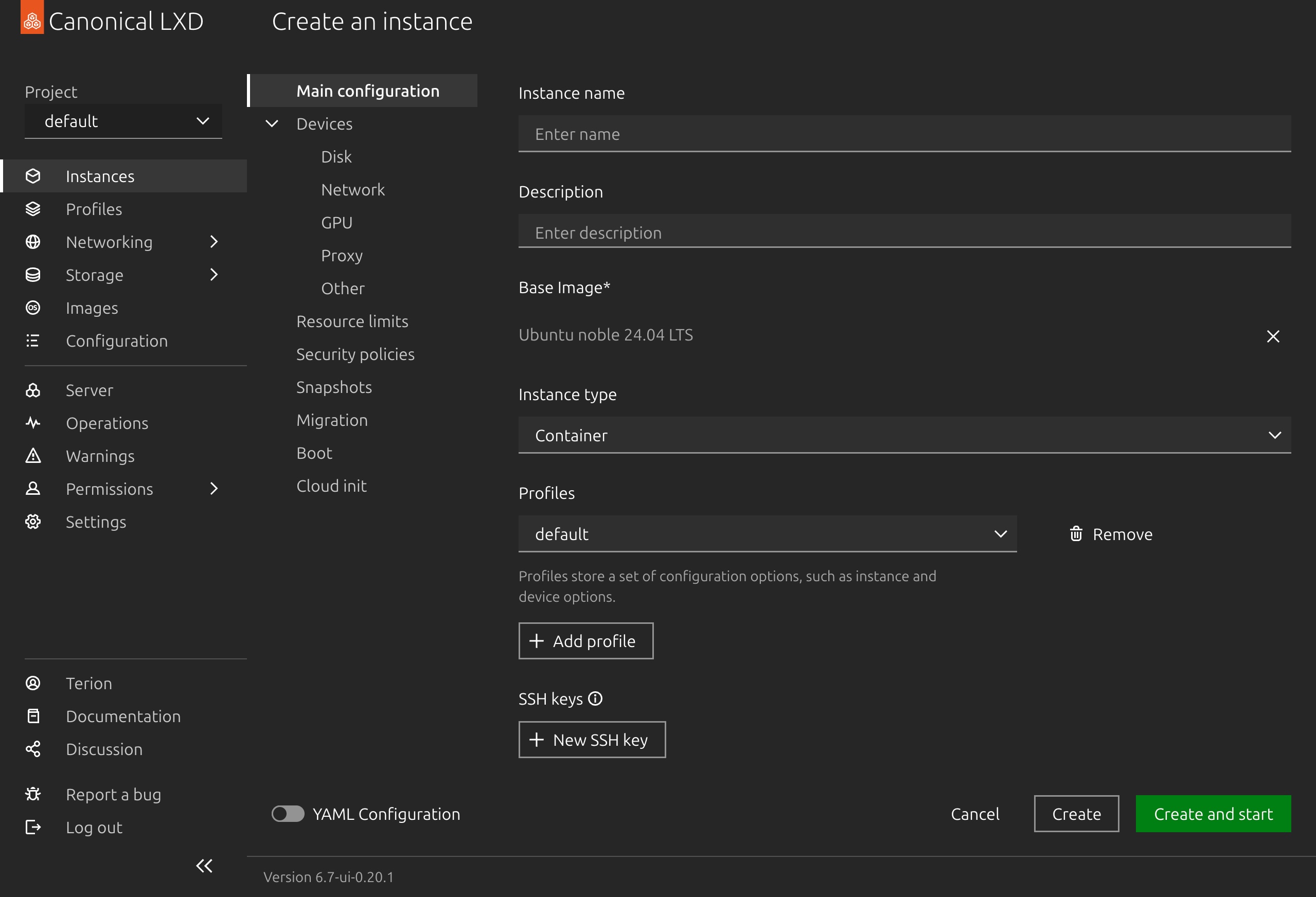
lxd.<your-domain>. - Navigate to the Instances tab on the left sidebar.
- Click the Create instance button.
- Select the
ubuntu/24.04image. - Give the container a clear name (for example,
my-first-app). - Click Create and wait a few seconds for the container to start.
The Command Line Way
If you prefer the terminal, you can create the exact same container in one command. SSH into your Terrarium host and run:
trm launch ubuntu:24.04 my-first-app(By default, Terrarium automatically applies its secure container profile, which puts the container on the private terrarium-ovn network and gives it its own isolated ZFS storage.)
2. Setting Up an Application
Now that the container exists, you can run whatever you want inside of it.
For this example, let's just run a tiny, temporary web server.
From the LXD UI:
- Click on your
my-first-appinstance. - Go to the Console tab to open a terminal directly inside the container.
From the CLI:
trm exec my-first-appOnce you are inside the container's shell, run this command to start a simple Python web server on port 8080:
nohup python3 -m http.server 8080 >/tmp/http-server.log 2>&1 &Right now, that web server is running entirely privately. It is only accessible to other containers on your Terrarium network. The public internet cannot see it.
3. Publishing the Route
To expose this web server to the internet, you just need to add a user.proxy label to the container.
Terrarium watches for these labels. When it sees one, it automatically configures Traefik to route the traffic, provisions an SSL certificate, and opens the necessary internal firewall rules.
The Visual Way (LXD UI)
- In the LXD UI, click on your
my-first-appinstance. - Go to the Configuration tab.
- Click Edit YAML.
- Under the
config:block, add your proxy label. It should look like this:
config:
user.proxy: https://my-app.example.com:8080- Click Save.
The Command Line Way
On the Terrarium host terminal (not inside the container), run:
lxc config set my-first-app user.proxy "https://my-app.example.com:8080"You can also set the route during launch:
trm launch ubuntu:24.04 my-first-app --proxy https://my-app.example.com:80804. Applying the Change
Terrarium scans your containers for new proxy labels automatically every 60 seconds. If you don't want to wait a minute for your new site to come online, you can force it to sync immediately.
From the CLI:
terrariumctl proxy syncThat is the entire workflow. You have successfully created an isolated environment, started a service, and securely routed public internet traffic to it.
(Want to lock that app so only you can access it? Check out the Protecting Services with OIDC guide.)